



Event Calendar 
-
April 13. 10:00 - 17. 14:00
The Faculty of Economics and Business Administration’s (GTK) English-language Bachelor’s programme in Business Administration and Management has once again been awarded the international accreditation of the European Foundation for Management Development (EFMD), an elite organization dedicated to maintaining and enhancing the quality of higher education programmes.
In Hungary, only four universities, and across Europe merely 87 programmes, hold this prestigious recognition. This clearly demonstrates the Faculty’s commitment to continuous development and quality improvement.
On this occasion, we conducted interviews with Dr. habil. Benedek Nagy, Dean of the Faculty; Dr. Ildikó Pusztai-Varga, International Director; Dr. Beáta Vajda Kincsesné, Programme Director of BAM; and Dr. Zsófia Kürtösi, former Programme Director.
What exactly does EFMD accreditation mean, and why is it important for the SZTE Faculty of Economics and Business Administration?
Dr. habil. Benedek Nagy:
For me, this is strong confirmation that we are moving in the right direction. EFMD recognizes outstanding business programmes and institutions in Europe and worldwide, and being part of this circle means that we are visible on the map, competitive, and able to keep pace with the very best. It also means that we have clear plans and objectives, and we must regularly present and validate these ambitions with an organization that has extensive experience and broad international insight.
Dr. Ildikó Pusztai-Varga:
EFMD Programme Accreditation is an internationally recognized quality standard that certifies that the BAM programme meets the level of leading business schools across all major dimensions – strategy, curriculum, delivery, outcomes, and quality assurance. For SZTE GTK, this brings significant international prestige, visibility, and competitive advantage in the Central European region, particularly in attracting international students and partners. This is especially important as only a limited number of programmes worldwide, and only a few in Hungary, hold EFMD accreditation.
Dr. Zsófia Kürtösi:
EFMD is a non-profit international organization whose goal is to continuously improve the quality of management education. It is a network that includes not only higher education institutions but also civil organizations, business representatives, and consultants. By joining, we gain the opportunity to learn from others, adopt best practices, and discuss development directions. We can build research and other partnerships or participate in training programmes that support the development of educational programmes. These cover not only pedagogical issues but also internationalization, career and alumni services, and many other current topics.
What criteria did the committee consider when evaluating our BAM programme?
Dr. Ildikó Pusztai-Varga:
The committee assessed the institutional environment, strategic alignment, the quality of the curriculum and Intended Learning Outcomes (ILOs), programme structure, delivery methods, student experience and outcomes, as well as the functioning of quality assurance in line with EFMD standards. Special emphasis was placed on internationalization, ERS (ethics, responsibility, sustainability), corporate relations, digitalization, research-based education, and student-centred pedagogy.
Dr. Beáta Vajda Kincsesné:
A total of 71 criteria across five dimensions were evaluated, requiring explicit answers to several hundred questions. These covered everything from the learning and digital environment, sustainability considerations, and alignment between courses and learning outcomes, to assessment methods, student services, and the use of course evaluation results. In addition to the submitted documentation (data, self-assessment, student feedback, and all supporting materials), the evaluation was based on a two-day on-site visit by an international accreditation committee. This was therefore a thorough and in-depth review, not merely an administrative exercise.
What feedback was provided, and how can it support the Faculty’s development?
Dr. habil. Benedek Nagy:
The committee praised us in several areas and identified shortcomings in others, but overall deemed our performance satisfactory. They outlined areas for development for the next three years, for which they expect progress plans and measurable results. These include internationalization, strengthening alumni relations, and reducing student dropout rates. I am confident that progress in these areas will not only affect our accredited English-language programme but will also have a positive impact on the entire Faculty through the colleagues involved. Continuous maintenance, review, development, and measurement practices can make us a more effective institution.
Dr. Ildikó Pusztai-Varga:
The Peer Review Team (PRT) highlighted student-centredness, the diverse international student body, practice-oriented learning experiences, strong corporate connections, and positive student feedback as key strengths of the programme. At the same time, they identified three areas for improvement: more conscious tracking of academic progress linked to the measurement of learning outcomes (ILOs), further internationalization of the academic staff, and stronger involvement of the alumni community in supporting students and faculty. These will define our development priorities for the coming years.
What advantages does EFMD accreditation offer to our students?
Dr. habil. Benedek Nagy:
Recruitment for international programmes follows entirely different rules compared to Hungarian-language programmes. Students who choose us often have limited knowledge not only about Szeged but even about Hungary. For them, Szeged may seem just as distant as Pécs, Budapest, Kraków, or Prague. An accreditation like this provides guidance and reassurance, indicating that they can confidently choose us, as they will receive high-quality education, valuable knowledge, and a valuable degree.
Dr. Ildikó Pusztai-Varga:
For our students, EFMD accreditation signals that they are studying in an internationally benchmarked, practice-oriented, and continuously improved programme that is regularly evaluated by independent international experts. This enhances the international recognition of the degree, strengthens employer trust, and improves employability. This is reflected in the fact that more than 84% of our graduates find employment within six months, most of them abroad, with a significant proportion working in managerial or entrepreneurial positions.
Dr. Zsófia Kürtösi:
For students, this accreditation primarily indicates that the programme is continuously evolving not only in its content but also in its supporting services. It also shows that they are part of an internationally recognized programme, which expands and improves the quality of our international partnership network for study mobility opportunities. It is also important for students that their opinions contribute to shaping and improving the programme. Feedback is not only collected through course evaluations but also through detailed student reports submitted alongside the accreditation self-assessment, where students can highlight both strengths and areas for improvement.
Dr. Beáta Vajda Kincsesné:
The “badge” itself makes our graduates’ degrees more valuable and recognized internationally. Many prestigious partner institutions specifically seek cooperation with accredited institutions, for example when accepting student mobility applications. At the same time, it guarantees our students that we continuously strive to improve quality and keep the programme up to date.
What further developments are planned in terms of internationalization?
Dr. habil. Benedek Nagy:
One, but not the only, path to internationalization is strengthening our academic staff with non-Hungarian colleagues. We must explore and better utilize opportunities to offer academic and cultural diversity in cooperation with our partners. A great example is our annual International Week, where we welcome guest lecturers from partner institutions who share their knowledge, experience, and perspectives with our students. This is internationalization in practice, even if on a smaller scale.
Dr. Ildikó Pusztai-Varga:
In the next cycle, the Faculty aims to further internationalize its academic staff, build a more diverse academic community, and strengthen outgoing student mobility so that more students gain international study and work experience. We also plan to further expand the role of international corporate and academic partners in the programme and more consciously communicate the unique international learning experience of BAM to make it even more attractive to students both in Hungary and abroad.
EFMD Accreditation Team
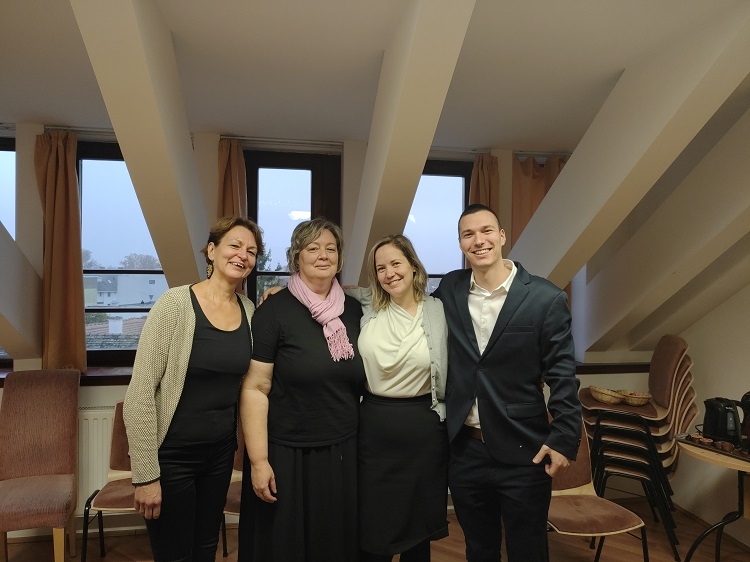
In the photo: Dr. Ildikó Pusztai-Varga, Dr. Zsófia Kürtösi, Dr. Beáta Vajda Kincsesné, Dániel Szládek
We would like to express our sincere gratitude to the team responsible for the reaccreditation process: Dr. Ildikó Pusztai-Varga (International Director), Dániel Szládek (Accreditation Manager), Dr. Beáta Vajda Kincsesné (Programme Director), Dr. Zsófia Kürtösi (former Programme Director and mentor), and Dr. Klára Kazár (Data Manager) for their valuable work. We also thank all colleagues who contributed to this success.

The Faculty of Economics and Business Administration’s (GTK) English-language Bachelor’s programme in Business Administration and Management has once again been awarded the international accreditation of the European Foundation for Management Development (EFMD), an elite organization dedicated to maintaining and enhancing the quality of higher education programmes.


